Get 20% off orders over £50 with discount code REWIND
 01423 319041


What do you want to convert?
Back to Blogs
Why Did VHS beat Betamax?
Sean Parle • 22 October 2026
Why Did VHS Beat Betamax?
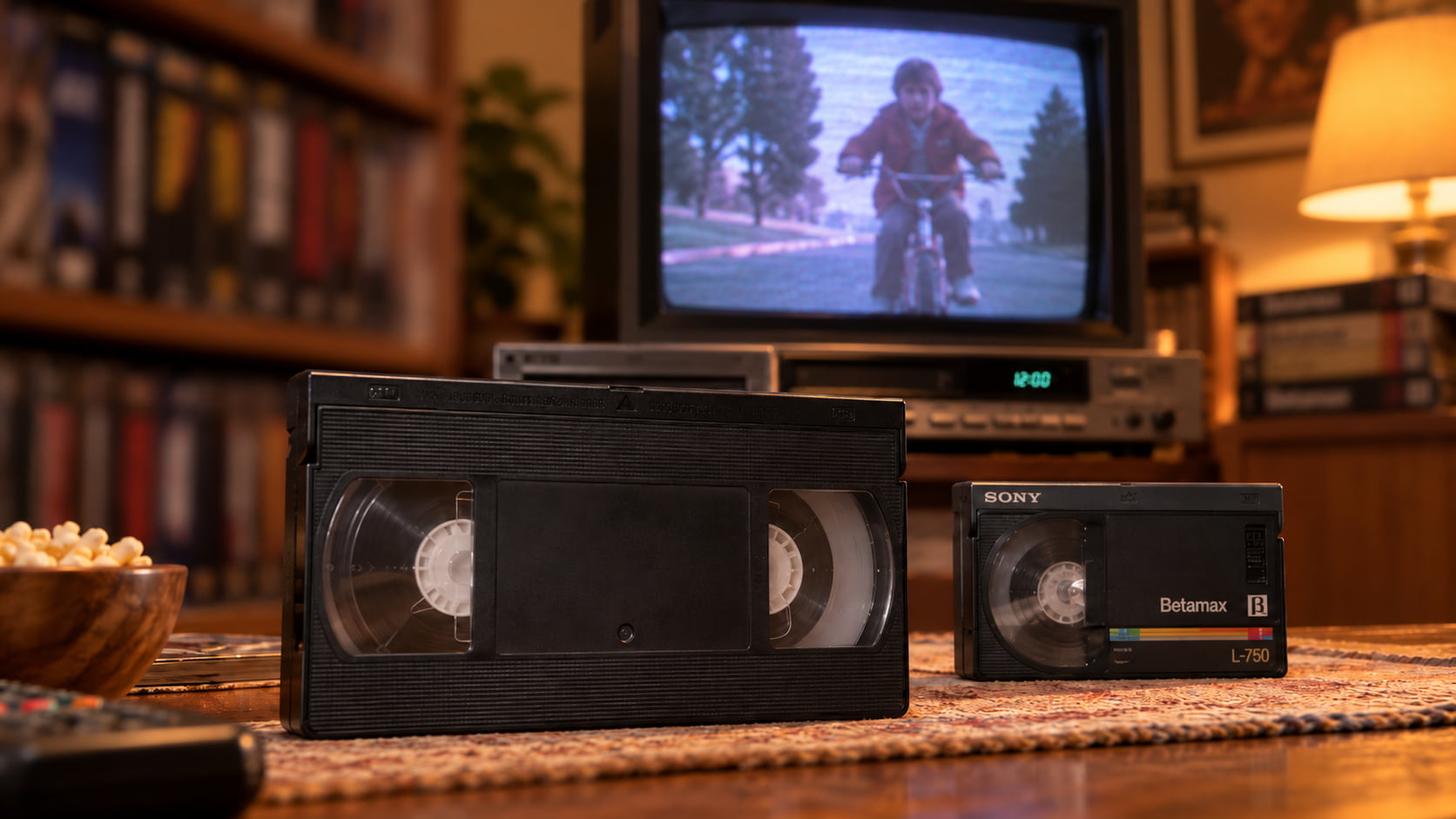
VHS beat Betamax because it recorded for longer, cost less and was built by far more companies. Sony’s Betamax arrived first and arguably had the sharper picture, but its tapes only lasted an hour at launch, while VHS managed two hours from day one, enough for a whole film. JVC also let rival manufacturers make VHS machines, which flooded the shops with cheaper recorders, and once the video rental shops picked a side, the fight was effectively over.
Key Points
Betamax launched in 1975 with one-hour tapes, while VHS arrived in 1976 able to record two hours, long enough for a full film.
JVC licensed VHS to dozens of manufacturers, so by 1984 around 40 companies made VHS machines compared with just 12 for Betamax.
Video rental shops gradually dropped Betamax titles, and once the films disappeared, buyers followed.
Sony started making VHS recorders in 1988 but kept producing Betamax machines until 2002 and tapes until 2016.
Betamax Got There First
Sony had a serious head start. Betamax was announced on 16 April 1975 and went on sale in Japan the following month, according to Wikipedia’s history of the format. JVC didn’t show off its first VHS recorder, the Victor HR-3300, until 9 September 1976.
That gap mattered. A case study from New York University’s Stern School of Business notes that more than 100,000 Betamax machines had already been sold by the time VHS launched. On paper, Sony was miles ahead.
Here’s the twist that makes the whole story more interesting. Sony, JVC and Matsushita (Panasonic’s parent company) weren’t strangers. They had worked together on U-matic, a professional tape format released in 1971. Then they went their separate ways, each chasing their own home video system.
In our view, Sony’s lead should have been unbeatable. Being first with a working product is usually half the battle. The fact that Sony still lost tells you how many other things went wrong.
The Meeting That Changed Everything
Before Betamax launched, Sony chairman Akio Morita showed the machine to executives from Matsushita, JVC and the American giant RCA. He wanted them to adopt it as the industry standard. The NYU case study describes Sony’s attitude as essentially: we’ve finished it, now follow us.
It didn’t go down well. JVC said it would rather develop its own system.
Then came the moment that’s been retold for decades. Konosuke Matsushita, founder of the company, reportedly put a Sony machine and a JVC machine side by side with their lids off. He chose JVC’s design because it had fewer components, which meant it could be made more cheaply. According to the American National Standards Institute’s blog, he said it pained him to reject Betamax, but the JVC product was simpler.
That decision was huge. Matsushita was JVC’s majority shareholder and one of the biggest electronics firms on the planet. Its backing persuaded Hitachi, Mitsubishi and Sharp to sign up to VHS too.
The lines were drawn. On one side stood JVC, Matsushita, Hitachi, Mitsubishi, Sharp and Akai. On the other were Sony, Toshiba, Sanyo, NEC, Aiwa and Pioneer.
Recording Time: The Real Battleground
If you want one reason above all others, this is it.
When Betamax launched, a tape could only hold one hour. That’s not long enough for most films, and it’s certainly not long enough to record an evening’s telly while you’re out. VHS could manage two hours from the start.
Sony knew this and chose to stick with it. According to Click Americana’s look back at the format, Sony argued that stretching Beta’s recording time would hurt picture quality too much. That’s a very engineer-minded way of thinking. Most families didn’t care about a few extra lines of detail. They cared about whether the end of the film would be on the tape.
Then RCA got involved. Wikipedia’s account of the format war says RCA had talks with Sony but felt the recording time was too short, insisting on at least four hours, reportedly because that was roughly the length of an American football game. Matsushita was happy to oblige. It built VHS machines for RCA, and the first VHS recorder sold in the United States, the RCA VBT200, went on sale on 23 August 1977.
Sony did extend Betamax’s running time over the following years. But every time it caught up, VHS moved the goalposts again. Personally, we think this is the clearest example in the whole saga of a company building the product it wanted to make rather than the one people actually needed.
Was Betamax Actually Better Quality?
Sort of. On paper, yes.
Betamax offered slightly higher horizontal resolution than standard VHS, roughly 250 lines against about 240 according to most technical accounts. Its machines also had a reputation for solid build quality, and plenty of enthusiasts still swear by them today.
But here’s the honest truth. In a normal living room, on a normal 1980s television, most people couldn’t tell the difference. An older version of Wikipedia’s format war article points out that real-world picture quality depended heavily on the condition of the tape and the individual recorder. A good VHS machine with a fresh tape could easily look better than a tired Betamax.
Sony did push the quality further with SuperBeta, which boosted horizontal resolution by around 20% to roughly 290 lines. The problem? By the time it arrived, Betamax’s share in America and Europe had already fallen below 10%. Too little, far too late.
Our technicians see both formats regularly, and the gap in quality between a well-kept Betamax tape and a well-kept VHS tape is small. Storage conditions over the past 40 years usually matter far more than which format the footage was recorded on.
Licensing: Sony’s Biggest Mistake
JVC’s masterstroke was letting other companies in.
Wikipedia’s entry on VHS says JVC believed an open standard, shared among competitors, was better for the consumer. Whatever its motives, the effect was dramatic. Dozens of brands started making VHS recorders. They competed with each other on price and features, and prices tumbled.
Sony was far more protective. Wikipedia’s Betamax article notes that Sony initially resisted licensing the format, which limited how far it could spread. With fewer companies making Beta machines, there was less competition and less pressure to cut prices.
The numbers tell the story. By 1984, around 40 companies were making VHS machines, compared with just 12 for Betamax.
This is the bit we find most fascinating. Sony had the better reputation, the head start and the engineering pride. JVC simply had more friends. And in a format war, friends win.
The Video Shop Effect
Once lots of people owned VHS recorders, video shops had every reason to stock more VHS tapes. Once the shops stocked more VHS tapes, even more people bought VHS recorders. It’s a snowball, and Betamax was standing at the bottom of the hill.
Most rental shops carried both formats at first. By the mid-1980s, many simply stopped buying new Betamax titles. Wikipedia’s history of video rental shops notes that most stores eventually phased out their Betamax sections altogether and went all-VHS.
For the average family, that settled it. Why buy a machine if you can’t rent the latest films for it on a Friday night?
How the War Played Out in Britain
The UK was a bit late to the party. Both Betamax and VHS reached British shops around 1978, according to the Curious British Telly newsletter. Philips also had its own format here, Video 2000 (V2000), which was popular in parts of Europe.
Betamax actually did better in Britain than in the US for a while. An archived version of Wikipedia’s format war article states that the best-selling video recorder in the UK in 1983 was a Sanyo Betamax machine, the VTC5000. Beta peaked at around a quarter of the UK market.
Sources disagree on exactly when that peak was. Some say 1981, others 1984. Either way, the fall was steep. By 1986, Beta’s UK share was down to around 7.5% and still sliding.
Renting played a big part here too. With only three TV channels at the start of the 1980s, home video was a big deal in Britain, and plenty of households rented their recorders from high street shops rather than buying them outright. The rental companies tended to favour VHS, which pushed even more homes into that camp.
V2000 didn’t survive either. Philips cancelled it in 1985, making it the first casualty of the format war.
The Adult Film Myth
You’ve probably heard this one. VHS supposedly won because the adult film industry chose it over Betamax.
It’s a great pub story. Unfortunately, there’s no solid evidence for it. Wikipedia’s account of the format war states plainly that no clear evidence exists one way or the other, and Esquire Middle East has described the popular legend as almost entirely false.
Adult films were certainly sold on videotape in the late 1970s, and they did appear on VHS. But the reasons that are properly documented, such as recording time, price, licensing and rental shop support, explain the result far better. We’d file this one under “too good to be true”.
When Did Sony Admit Defeat?
Sony held out for a surprisingly long time. It finally started making its own VHS recorders in 1988, which most people saw as waving the white flag.
Betamax didn’t vanish overnight, though. Sony kept making Betamax recorders until 2002, and only stopped selling blank Betamax tapes in March 2016. That’s more than 40 years after the format first appeared.
Betamax technology also lived on in a very different form. Sony’s professional Betacam system, which used the same size cassette, became the standard in TV newsrooms and studios around the world. So while Sony lost the battle for your living room, it won the one for the BBC’s edit suites.
What the Format War Taught Everyone
The VHS versus Betamax fight became the textbook example of a format war. Business schools still teach it.
The lesson is pretty simple. The best technology doesn’t automatically win. Price, convenience, partnerships and content matter more. You could see the same pattern decades later in the battle between Blu-ray and HD DVD, where the format with the stronger backing from film studios and retailers came out on top.
In our opinion, Sony’s mistake wasn’t building a bad product. Betamax was a good product. Sony’s mistake was assuming that quality alone would be enough, and refusing to bend on the things ordinary buyers actually cared about.
Got Betamax or VHS Tapes in the Loft?
Here’s where the format war still matters today. Because Betamax lost, far fewer Betamax players were made, and working machines are now much harder to find than VHS ones. If your family backed Beta in the 1980s, your home videos may be sitting on tapes that almost nobody can play any more.
Every year that passes, both formats age a little more. Tapes can go mouldy, stick, snap or simply fade.
We convert Betamax as well as VHS, VHS-C, Super VHS and camcorder formats, and we handle NTSC and SECAM tapes as well as PAL. Our technicians can repair snapped tape, clean mouldy tape and fit new shells to broken cassettes. We transfer at standard definition, because that’s what the original recording holds, and we don’t use AI upscaling, which still makes too many mistakes to trust with your memories.
Whichever side of the format war your family was on, the footage deserves saving. Get your VHS tapes converted to digital before they become impossible to play.